550 hours of classroom study and 480 hours of supervised practicum across three real placements — preparing you to apply for Early Childhood Educator certification.

Program Overview
Our Early Childhood Education Certificate is a complete, 11-month training program that prepares you to apply for Early Childhood Educator certification through the B.C. ECE Registry. You complete 550 hours of academic study and 480 hours of supervised practicum across three placements in licensed early learning settings.
Classes & Courses
We deliver the program in person at our Vancouver location, with evening classes Monday to Friday, 4:30 p.m. to 9:30 p.m. Ten courses cover child development, curriculum planning, positive guidance, health and safety, and professional communication with families and colleagues.
Certification
You can also apply for B.C. ECEA certification part-way through the program, once you finish EC1100, EC1200 or EC1300. That lets you start working in a licensed setting while you complete the rest of your certificate.
Graduates apply to the B.C. ECE Registry for certification. The Registry reviews each complete application and makes the final decision.
English Admission Requirement
Our English for Academic Purposes course is available in Vancouver and Kelowna. It can help you prepare for the academic reading, writing and communication this certificate requires. Contact our Admissions Team when you are unsure whether your current English level meets the requirement.
Academic Admission Requirement
Additional Requirements
Because you will work directly with young children during your practicums, this program carries screening requirements that our shorter programs do not. Start these early. The criminal record check and TB test can take several weeks, and we cannot confirm your seat until the full file is complete.
| Tuition & Fees | |
|---|---|
| Tuition (Domestic): | $13,090 |
| Tuition (International): | $19,900 |
| Application Fee (Domestic): | $150 |
| Application Fee (International): | $250 |
| Student Services Fee: | $250 |
Textbooks are not included and must be purchased separately. Our ECE Textbook List lists out what you will need. Published 2026 rates apply to registrations received during the stated fee period. Review our current Tuition and Fees before submitting payment or finalising your budget.
Domestic students should also look at the B.C. government’s ECE Education Support Fund and bursary options, which cover tuition costs for eligible students. Ask our Admissions Team what is currently open.
| Semester 1: Academic Study |
|---|
| Term 1 – 2 WEEKS |
| EC1000 History, Philosophies, and Foundations of ECE |
| Term 2 – 4 weeks |
| EC1100 Understanding Child Growth and Development * |
| Term 3 – 2 weeks |
| EC1900 ECE Curriculum 4 – Creative Expression |
1-week break**
| Semester 2: practicum | |
|---|---|
| 8 weeks | |
| Early Childhood Education Practicum 1 | |
| Semester 3: Academic Study |
|---|
| Term 1 – 2 weeks |
| EC1200 Positive Approaches to Guiding Children’s Behaviour * |
| Term 2 – 2 weeks |
| EC1500 Program Planning and Development in ECE |
| Term 3 – 2 weeks |
| EC1600 ECE Curriculum 1 – Music & Movement |
| Term 4 – 2 weeks |
| EC1800 ECE Curriculum 3 – Science & Math |
1-week break**
| Semester 4: practicum | |
|---|---|
| 6 weeks | |
| Early Childhood Education Practicum 2 | |
| Semester 5: Academic Study |
|---|
| Term 1 – 2 WEEKS |
| EC1300 Health, Safety, and Nutrition in ECE * |
| Term 2 – 2 weeks |
| EC1400 Interpersonal Communication and Professionalism in ECE |
| Term 3 – 2 weeks |
| EC1700 ECE Curriculum 2 – Language and Literacy |
1-week break**
| Semester 6: practicum | |
|---|---|
| 6 weeks | |
| Early Childhood Education Practicum 3 | |
* Students are eligible to apply for the ECEA certificate from the ECE Registry after the completion of one of these courses: EC 1100, EC 1200, EC 1300.
** Cohorts overlapping Christmas will include an extra 2-week break for the holiday
– Sequence of the program delivery and courses will be dependent on the corresponding intake date
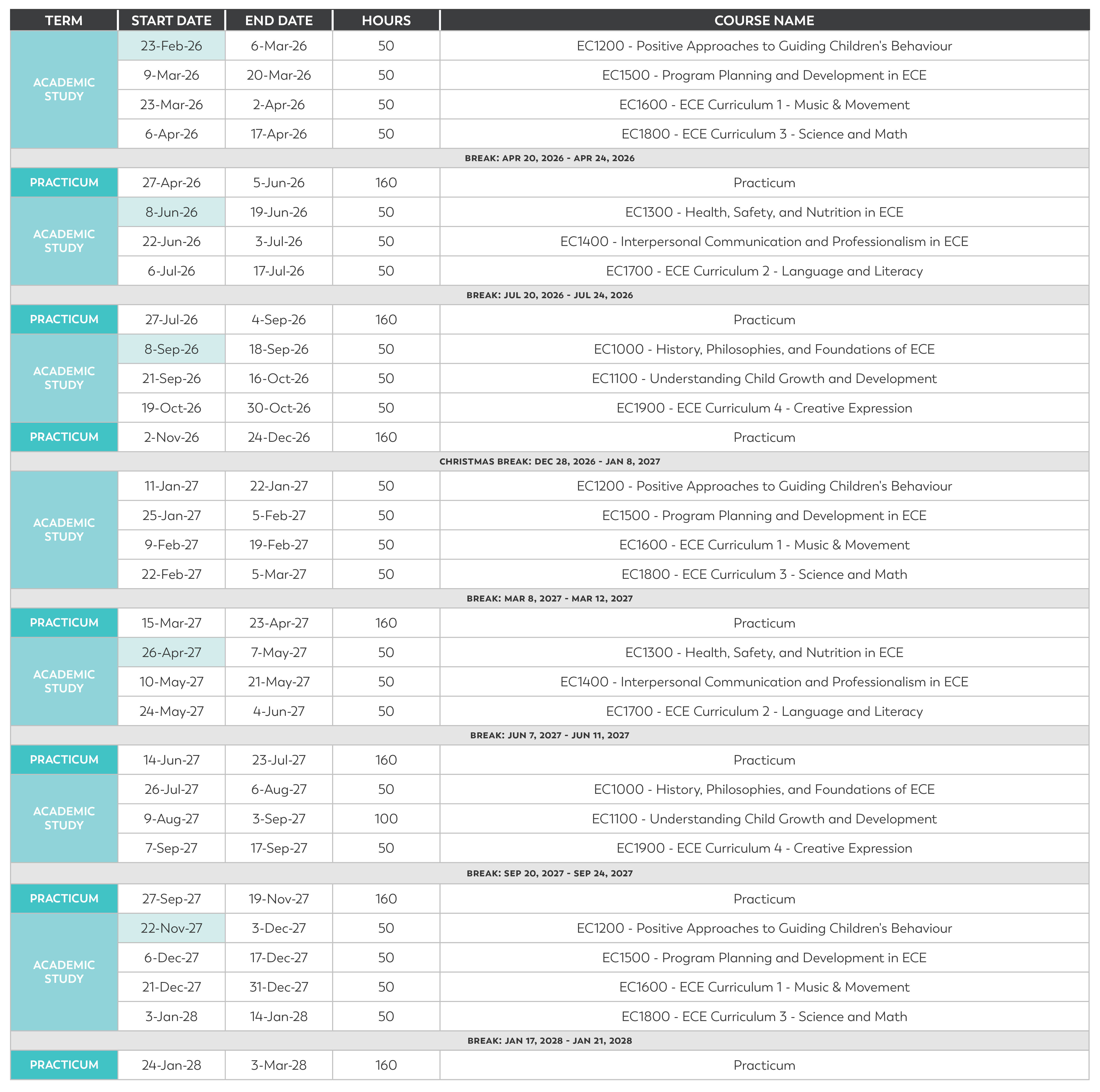
Sample Program Schedule
Important Dates
Upon the completion of the program, graduates will have the ability to:
Career Opportunities
Possible job titles include Early Childhood Educator, Early Childhood Education Assistant, early childhood program coordinator, preschool teacher and daycare supervisor.
Early childhood education is one of the top ten care economy occupations in British Columbia.
Average Salary Per Year
Source: 2025 job bank wage
Job Outlook in BC
Source: WORKBC.CA
| Occupations | New Job Openings (2025 – 2035) |
Median Wage Rate |
|---|---|---|
| Early childhood educators and assistants (NOC 4214) |
13,010 | $24/hr |
Read that median with the grouping in mind. WorkBC notes that the occupational code combines educators and assistants, and that assistants are paid less, which pulls the reported figure down. Certified ECEs generally sit above it, and the province’s ECE Wage Enhancement adds an hourly top-up for those who qualify.
Actual compensation depends on certification level, experience, location, employer and responsibilities. Employment is not guaranteed.

An Early Childhood Educator plans, leads and evaluates programs that support the learning, development and well-being of young children.

The full ECE pathway and the shorter ECEA pathway lead to different scopes of practice.
Choose our ECE Certificate when you want comprehensive study, supervised practicums, curriculum training and a pathway to full ECE certification. Choose our ECEA program when you want to enter the field in 2 to 4 weeks and test whether early childhood education is the right long-term direction. Courses you complete in the ECEA course count towards this certificate.
The program runs for 45 weeks in total: 5.5 months of academic study and 5 months of practicum. You finish with a credential that meets the education requirement for B.C. ECE certification, rather than a single-course certificate.
Three placements in daycare centres, nurseries and family centres let you apply classroom theory with real children and real teams. Employers ask about practicum experience, and graduates who have run activities under supervision interview better than those who have only studied theory.
EC1100, EC1200 and EC1300 each satisfy the education component of a first B.C. ECEA application. Once you have completed one of them, you can apply to the ECE Registry for an ECEA certificate and take paid work in a licensed setting while you finish the rest of the program.
Classes run Monday to Friday from 4:30 p.m. to 9:30 p.m. The schedule may suit students who have daytime responsibilities, although practicum blocks run during regular child care hours and will need daytime availability.
Ten courses cover child development, four curriculum areas, program planning, positive guidance, health and safety, professional communication, and the history and philosophy of the field. Nothing is left for you to fill in later through separate courses.
We guide you through course planning, practicum documentation, and preparation for your B.C. ECE Registry application. The Registry issues certification, and completing the program does not issue it automatically.
The program runs across six semesters that alternate between academic study and practicum. Sequence of the program delivery and courses will be dependent on the corresponding intake date.
The practicum component totals 480 hours across three supervised placements in registered ECE centres, daycares and family centres.
By the end of the third placement, you will be able to plan and deliver an integrated program that is age-appropriate, culturally sensitive and responsive to each child in an inclusive setting.
One point worth planning around: the B.C. ECE Registry does not count practicum hours towards the 500 hours of supervised work experience needed for an ECE Five Year Certificate. Students can start to collect the 500 hours as soon as they start the ECE Basic program (practicum not included).

Our currently published upcoming intakes are:
All current intakes run through the December holiday period and include an extra two-week break. The November 22 intake includes an extra 2-week holiday break.
– During practicum, there is a seminar once a week. There are no other academic courses offered during the practicum period. Dates and seat availability can change, so contact our team before making travel, immigration or employment arrangements.

Eleven months, or 45 weeks in total. That breaks down into 550 hours of academic study and 480 hours of practicum, with one-week breaks between semesters.
Complete a basic early childhood education program recognised by the B.C. ECE Registry, then apply to the Registry with your character, health and education evidence. New graduates receive an ECE One Year Certificate and move to a Five Year Certificate after 500 hours of supervised work experience.
No. We deliver all courses in person at our Vancouver location, and practicums take place in licensed early learning settings.
No. The B.C. ECE Registry excludes practicum and placement hours that formed part of your education. Your 500 hours must come from paid or volunteer work outside the program.
Many students do. After finishing EC1100, EC1200 or EC1300, you can apply for a B.C. ECEA certificate and take supervised work in a licensed setting. Check your own study authorisation conditions first.
EAP 300 with a final grade of at least 75%, IELTS Academic 6.0 or higher, or TOEFL iBT 79 or higher.
Because you work directly with children under five during your practicums. B.C.'s Criminal Records Review Act and licensed child care health requirements apply to everyone in that position.
Yes. International tuition is currently CAD $19,900, plus the international application fee, student services fee and textbook costs. Confirm your individual immigration and study-authorisation requirements before enrolling.
A certified ECE can work alone or as the primary educator with children aged three to five. An ECEA works alongside a certified ECE and cannot lead a program independently.
No. Successful completion makes you eligible to apply. The B.C. ECE Registry reviews the complete application and issues certification when all requirements are satisfied.
Domestic students may be eligible for provincial ECE bursaries and the ECE Education Support Fund. Programs and eligibility change, so ask our admissions team what is currently open.